
Resources & Insights
Garden Maintenance in Florida
What It Actually Takes to Keep Your Landscape Under Control
Weeds come back in the same spots. Plants push out of place. Beds lose their shape. It doesn’t feel like neglect. It feels like nothing holds. A constant tug of war.
That’s because, in Florida, landscapes don’t “hold” on their own. For some homeowners, that’s okay, but for most, a tidy and maintained landscape is the expected standard.
Landscapes are always growing, always competing, and always changing. If that growth isn’t being managed consistently, the yard doesn’t stay stable. It drifts and deteriorates.
Many homeowners don’t realize that cycle until they’ve already been stuck in it for a while.
Table of Contents
- What Garden Maintenance Actually Is (and What It Isn’t)
- Garden Maintenance vs. Lawn Care
- Why Garden Maintenance Works Differently in Florida
- The Biggest Problem Homeowners Run Into
- Why Cleanups Don’t Work Long-Term
- Why Weed Pressure Is the Real Battle in Florida
- Why the First 1–2 Years Matter More Than Anything
- The Core Work That Keeps a Landscape Healthy
- Seasonal Awareness (Even Without a True Off-Season)
- Native vs. Florida-Friendly Landscapes
- What a Well-Maintained Landscape Actually Looks Like
- What It Takes to Keep a Landscape Under Control
- Getting Out of the Cleanup Cycle
- Garden Maintenance in Florida Shouldn’t Be About Perfection
What Garden Maintenance Actually Is (and What It Isn’t)
Garden maintenance is not mowing your lawn, it’s not blowing off debris, and it’s not an occasional cleanup when things get out of control.
It’s the ongoing, consistent management of everything happening in your planting beds.
That includes:
- Weeding (and more importantly, preventing weed pressure from building by depleting the seed banks and starch reserves)
- Pruning and shaping plants based on how they grow or how we want them to grow, not just cutting them back or never pruning them at all
- Managing plant spacing and competition
- Monitoring irrigation and how water is affecting growth
- Keeping the overall structure and intent of the landscape intact as it matures
It’s not about making the yard look “done.” It’s about keeping it from getting out of balance in the first place.
Garden Maintenance vs. Lawn Care
Lawn care is predictable. You mow, edge, and blow. It happens on a schedule, and the results are visible right away. The expectation is virtually standard across all lawns, on all properties, in all states.
Garden maintenance is different.
The real work is happening in the beds where plants are growing, competing, and changing constantly. That work requires observation and adjustment. It’s not the same every visit, because the landscape isn’t the same every visit.
Expectations and standards can vary from one property to the next. Diverse plant pallets can encompass a wide range of different pruning and care metrics to achieve. Design intents can fluctuate, where one is more formal and another is more organic and natural. Both still need maintenance, but the level and type is different. There is less predictability and universal expectation with the details of garden maintenance.
You can have a perfectly maintained lawn and still feel like your yard is out of control. That’s because lawn care doesn’t always address what’s actually driving most of the change.
Why Garden Maintenance Works Differently in Florida
In other parts of the country, landscapes have a rhythm. There’s a growing season, then a slowdown. That pause gives homeowners time to catch up and reset. It creates an obvious end and an obvious beginning.
Florida doesn’t give you that break.
Growth happens most of the year. Even in cooler months, things rarely stop long enough to catch your breath. The seasons blend, and therefore growing seasons do as well. Many species stagger their dormancy periods, and in some years, plants barely stop growing at all.
On top of that, you’re dealing with:
- Heavy weed pressure that cycles continuously
- Rainfall that can trigger rapid growth
- Year round window for pests and diseases
- Sandy or non-native soils that don’t hold nutrients or moisture evenly
- Irrigation systems that often don’t match plant needs
All of that creates one reality: Your landscape is always moving, always changing, and always giving you something new to address.
If it’s not being guided, it’s moving in whatever direction benefits the plant most, which is not necessarily the direction you want.
The Biggest Problem Homeowners Run Into
The issue is the approach. What usually happens looks like this:
- The yard starts to feel overgrown and the weeds rapidly takeover
- You clean it up or have it serviced
- It looks good again
- A few weeks or months later, the same issues come back
That’s not a maintenance plan. That’s a reset cycle that will continue in perpetuity. It’s a reactive response to overwhelming change rather than a proactive approach that will solve many of the underlying problems.
Why Cleanups Don’t Work Long-Term
Yet, cleanups don’t change how a landscape grows month to month. They are not always able to capture the most optimal time to pull weeds or prune to promote more blooms. Essentially, seasonal cleanups should always accompany a good maintenance plan to deal with larger seasonal changes. This means a less intense seasonal clean up more focused on the big picture and a better looking landscape year round through frequent maintenance focusing on the finer details.
By the time a cleanup happens:
- Weeds have already reseeded and rebuilt starch reserves
- Plants may have already pushed beyond their ideal shape, getting long and leggy
- Growth patterns are already shifting
- Plants have exceeded their optimal pruning window
- Irrigation concerns were not addressed
So, even though everything gets cut back and all the weeds get pulled, some of the conditions that caused the problem are still there.
That’s why the same areas keep returning to what they were.
It’s not that the work didn’t help. It just didn’t hold, and it can’t be expected to hold.
Why Weed Pressure Is the Real Battle in Florida
Weeds in Florida establish quickly, spread aggressively, and take advantage of any gap in coverage. Plus, since the growing season is so long, they don’t really stop.
What most homeowners don’t see is that weeds are usually active before they show up.
By the time you notice them, they’ve likely already:
- Rooted deeply
- Spread by rhizomes, stolons, or runners
- Begun building starch reserves via photosynthesis
- And possibly even reseeded
That’s why pulling weeds after they’re highly visible doesn’t solve the problem. It just resets the problem temporarily.
Real weed control comes from staying ahead of that cycle by reacting early and frequently when weeds are in the seedling growth phase.
Why the First 1–2 Years Matter More Than Anything
The old plants and weeds were removed, the soil was smoothed out, and a thick layer of mulch was applied.
During the new installation, however, soil was disturbed, bringing dormant seeds to the surface and exposing them to air and light. Also, when weeds with large underground starch reserves are pulled, small fragments of those starch reserves still remain.
The soil disturbance, air, and frequent irrigation make for the perfect conditions for seeds to germinate and for starch reserves to push new growth. No matter how well done the site preparation was and mulch thickness is, new weeds will emerge.
In addition, as immature plants are installed at different ages, they will start growing and establishing at different rates. Some will establish and fill in within a couple of months, while others may take several years before filling in.
The whole landscape requires frequent watering to establish the new plants and keep the soil moist for weeks to months.
So, in reality, the first year or two is the most important time for maintenance.
That’s when:
- Plants are establishing their root systems
- Frequent irrigation is required
- Spacing is still being defined
- Growth patterns are forming
Until plants fill in, large areas of the landscape are open, allowing plenty of light in. If maintenance isn’t consistent during that window, a few things happen:
- Faster-growing plants take over space
- Slower plants get crowded out
- Weeds fill in the gaps before plants can
- Watering schedules remain unaltered
- Small trees lose their shape
Left to itself, the landscape doesn’t “grow into place.” It grows out of balance and can quickly become overwhelming. Worst of all, it can leave you with a sour taste after all the hard work and investment you put into its creation.
At that point, you’re no longer maintaining your landscape but correcting it. You’re working to get it back on track rather than keeping it on track.
The Core Work That Keeps a Landscape Healthy
A good maintenance program will aid in both aesthetics and landscape health.
Weeding (and Preventing Weed Cycles)
The goal is to get to weeds early in the seedling or emergence phase and reduce the conditions that allow them to keep coming back.
Remember: in Florida, every season has its weeds. That means it’s important to:
- Maintain plant density to reduce open space for weeds
- Address early growth before it spreads or seeds
- Stay consistent enough to break the cycle, don’t give up!
With early and consistent action, it’s very easy to stop the cycle and begin reducing the burden or, as we call it, “break the seed bank.”
Pruning (Not Just Cutting Back)
In reality, pruning is about directing and encouraging growth while creating a healthier plant and landscape, which are all an encouraged part of any garden maintenance program. It allows us to guide the plant to do more of what we want it to do. So, careful and intentional pruning with the future result and current health of the plant in mind is the key.
Improper pruning can result in reduced health, flowering, and aesthetics of the landscape, which all stem from the following:
- Too frequent and heavy cutbacks (over-pruning)
- Pruning at the wrong time of year
- Pruning without intent
- Improper pruning technique
Heavy cutbacks too frequently result in stunted growth that can never photosynthesize enough to thrive. This can be very stressful for plants over and over again. Never remove more than ⅓ of the plant more than once a year or every couple of years.
Wrong timing, such as pruning right before or in the middle of winter, can cause permanent damage in the event of frost or freeze. It can also remove upcoming flower buds reducing the color or wildlife factor of the plant.
Jumping into pruning without a plan results in regrowth that misses the mark or expectation.
And improper technique can open the plant up to pests and disease or unaesthetic stubs and nubs left behind.
Neglecting to prune altogether, either by accident or out of fear, can also have adverse effects on the landscape and aesthetics. In such situations, plants:
- Get long and leggy
- Shed lower leaves, exposing lower branches that may never regrow leaves
- Bloom less
- Become victims of pests or diseases
- Become weak
Overall, unpruned plant growth becomes crowded, random, and messy.
Ultimately, unpruned plants look visibly unkempt. By contrast, good pruning:
- Maintains shape and aesthetics over time
- Controls direction of growth
- Prevents overcrowding
- Reduces pest and disease
- Promotes blooming
- Encourages bright, vigorous growth
Pruning isn’t about how much you do or don’t cut. Rather, it’s about how and when you do it while focusing on your desired result for future growth.
Irrigation (One of the Most Overlooked Issues)
Let’s start with a fact: Did you know, nationwide, 50% of our precious potable water is used for landscaping? That’s why good landscape design and irrigation management is so crucial, not just from a plant health perspective but also from that of sustainability.
Watering needs to happen with the perfect balance. Too much water can:
- Encourage weed growth
- Create shallow root systems
- Lead to plant stress, leaf drop, or root-rot over time
Too little water creates its own issues:
Both can result in plant or landscape failure.
Unfortunately, many landscapes are set once and rarely adjusted, even as plants mature and seasonal weather patterns come and go. Plus, irrigation timers can be confusing to operate, and plant water needs may be difficult to assess. These challenges affect everything else in the landscape.
Seasonal Awareness (Even Without a True Off-Season)
Growth speeds up in warmer, wetter months and slows slightly in cooler periods. Maintenance should adjust with that rhythm, but never cease.
The mistake that homeowners occasionally make is when they treat every month the same.
Native vs. Florida-Friendly Landscapes
Native plants are adapted to Florida, but they still:
- Grow
- Spread
- Compete
If they’re not managed, they can become just as overgrown as any other type of landscape.
On the other hand, Florida-friendly landscapes include both native and non-native plants and are usually more structured. They can look more controlled early on, but they often require more consistent pruning to maintain that look. They also typically require higher amounts of irrigation, fertilization, and pest management.
Neither option is or should be maintenance-free, so the real difference is in how each requires the maintenance to keep it up.
What a Well-Maintained Landscape Actually Looks Like
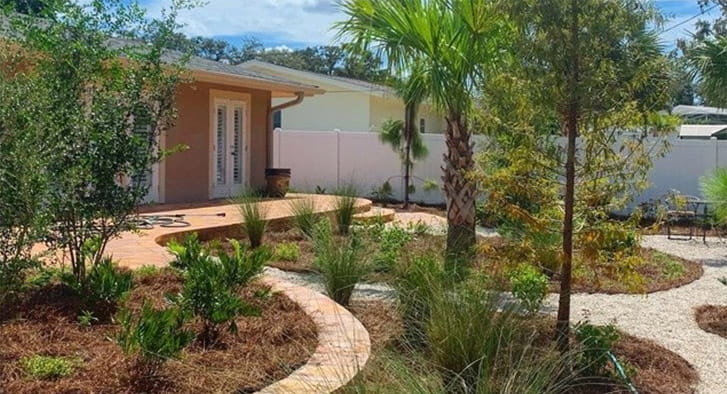
The truth is that landscapes shouldn’t feel overgrown, but they also shouldn’t feel sterile or over-manicured. Especially for native landscapes, a certain level of natural growth is expected and even desired to reap the complete benefits of dealing with native species.
What you’re looking for is control, not perfection. A well-maintained landscape:
- Keeps things looking fresh and touched
- Gradually gains control of the weed bank
- Feels balanced, not crowded or sparse
- Removes diseased or unaesthetic growth
What It Takes to Keep a Landscape Under Control
When it doesn’t:
- You fall into the cleanup cycle
- Problems repeat
- Costs increase over time
When it does:
- Work becomes less intensive and more consistent
- The landscape stabilizesv
- Maintenance starts to hold
Getting Out of the Cleanup Cycle
If it’s already built up, a reset may be necessary. But that reset only works when it’s followed by consistent maintenance that keeps disorder from building again.
If your landscape is relatively stable, then your focus shifts to simply staying ahead of growth.
Either way, the goal is the same: Stop solely reacting to the landscape and start managing it.
Garden Maintenance in Florida Shouldn’t Be About Perfection
Once that clicks, everything else becomes easier to manage. For most homeowners, that’s also the point where the landscape finally starts to feel under control.