
Resources & Insights
Garden Maintenance in Florida
What It Actually Takes to Keep Your Landscape Under Control
You clean everything up, it looks right for a week or two, and then it starts slipping again. Weeds come back in the same spots. Plants push out of place. Beds lose their shape.
It doesn’t feel like neglect. It feels like nothing holds.
That’s because in Florida, landscapes don’t “hold” on their own.
They’re always growing, always competing, and always changing. If that growth isn’t being managed consistently, the yard doesn’t stay stable—it drifts.
And most homeowners don’t realize that until they’ve already been stuck in the cycle for a while.
Table of Contents
What Garden Maintenance Actually Is (and What It Isn’t)
Garden maintenance is not mowing your lawn. It’s not blowing off debris. And it’s not an occasional cleanup when things get out of control.
It’s the ongoing management of everything happening in your planting beds.
That includes:
- Weeding (and more importantly, preventing weed pressure from building)
- Pruning and shaping plants based on how they grow—not just cutting them back
- Managing plant spacing and competition
- Monitoring irrigation and how water is affecting growth
- Keeping the overall structure of the landscape intact as it matures
It’s not about making the yard look “done.” It’s about keeping it from getting out of balance in the first place.
Garden Maintenance vs. Lawn Care
Lawn care is predictable. You mow, edge, and blow. It happens on a schedule, and the results are visible right away.
Garden maintenance is different.
The real work is happening in the beds—where plants are growing, competing, and changing constantly. That work requires observation and adjustment. It’s not the same every visit, because the landscape isn’t the same every visit.
You can have a perfectly maintained lawn and still feel like your yard is out of control. That’s because lawn care doesn’t address what’s actually driving most of the change.
Why Garden Maintenance Works Differently in Florida
In other parts of the country, landscapes have a rhythm. There’s a growing season, then a slowdown. That pause gives homeowners time to catch up and reset.
Florida doesn’t give you that break.
Growth happens for most of the year. Even in cooler months, things rarely stop long enough to stabilize.
On top of that, you’re dealing with:
- Heavy weed pressure that cycles continuously
- Rainfall that can trigger rapid growth
- Sandy soils that don’t hold nutrients evenly
- Irrigation systems that often don’t match plant needs
All of that creates one reality:
Your landscape is always moving.
And if it’s not being guided, it’s moving in whatever direction is easiest—not necessarily the one you want.
The Biggest Problem Homeowners Run Into
The issue is the approach.
What usually happens looks like this:
- The yard starts to feel overgrown
- You clean it up or have it serviced
- It looks good again
- A few weeks later, the same issues come back
That’s not a maintenance plan. That’s a reset cycle.
And it doesn’t solve the underlying problem.
Why Cleanups Don’t Work Long-Term
But it doesn’t change how the landscape is growing.
By the time a cleanup happens:
- Weeds have already reseeded
- Plants have already pushed beyond their ideal shape
- Growth patterns are already shifting
So even though everything gets cut back, the conditions that caused the problem are still there.
That’s why the same areas keep coming back.
It’s not that the work didn’t help—it just didn’t hold.
Why Weed Pressure Is the Real Battle in Florida
Weeds aren’t just an occasional issue here. They’re constant.
They establish quickly, spread aggressively, and take advantage of any gap in coverage. And because the growing season is so long, they don’t really stop.
What most homeowners don’t see is that weeds are usually already active before they show up.
By the time you notice them, they’ve already:
- Rooted
- Spread
- And often reseeded
That’s why pulling weeds after they’re visible doesn’t solve the problem. It just resets it temporarily.
Real weed control comes from staying ahead of that cycle—not reacting to it.
Why the First 1–2 Years Matter More Than Anything
A new landscape gets installed, and the assumption is that it should be easier to maintain.
In reality, the first year or two is the most important time for maintenance.
That’s when:
- Plants are establishing their root systems
- Spacing is still being defined
- Growth patterns are forming
If maintenance isn’t consistent during that window, a few things happen:
- Faster-growing plants take over space
- Slower plants get crowded out
- Weeds fill in the gaps before plants can
And once that happens, the landscape doesn’t “grow into place.” It grows out of balance.
At that point, you’re not maintaining it—you’re correcting it.
The Core Work That Keeps a Landscape Healthy
It’s not about doing everything. It’s about doing the right things at the right time.
Weeding (and Preventing Weed Cycles)
If you’re only addressing weeds when they’re visible, you’re always behind. The goal is to reduce the conditions that allow them to keep coming back.
That means:
- Maintaining plant density so weeds don’t have open space
- Addressing early growth before it spreads
- Staying consistent enough to break the cycle
Pruning (Not Just Cutting Back)
In reality, pruning is about directing growth.
Improper pruning—especially heavy cutbacks—can actually make plants grow back faster and more aggressively. You see this all the time with plants like viburnum or ligustrum.
Good pruning:
- Maintains shape over time
- Controls direction of growth
- Prevents overcrowding
It’s not about how much you cut—it’s about how and when you do it.
Irrigation (One of the Most Overlooked Issues)
Too much water can:
- Encourage weed growth
- Create shallow root systems
- Lead to plant stress over time
Too little water creates its own issues.
Most systems are set once and never adjusted, even as plants mature. That mismatch affects everything else in the landscape.
Seasonal Awareness (Even Without a True Off-Season)
Growth speeds up in warmer, wetter months and slows slightly in cooler periods. Maintenance should adjust with that rhythm.
The mistake is treating every month the same.
Native vs. Florida-Friendly Landscapes
Native landscapes are often described as low maintenance, and they can be—but that doesn’t mean they don’t require maintenance.
Native plants are adapted to Florida, but they still:
- Grow
- Spread
- Compete
If they’re not managed, they can become just as overgrown as anything else—just in a more natural-looking way.
Florida-friendly landscapes often include non-native plants and are usually more structured. They can look more controlled early on, but they often require more consistent pruning to maintain that look.
Neither is maintenance-free.
The difference is in how that maintenance shows up.
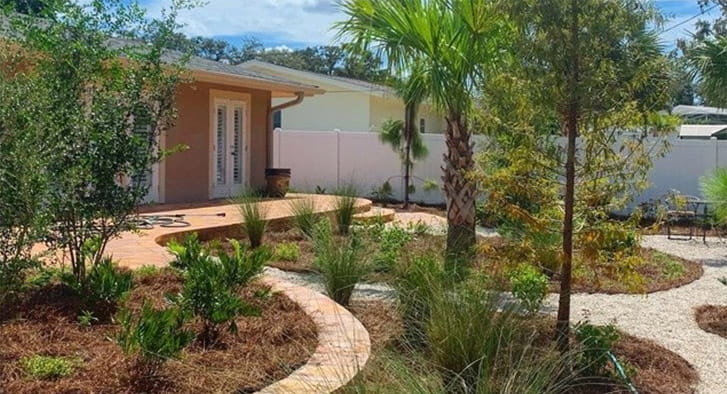
What a Well-Maintained Landscape Actually Looks Like
That’s another misconception.
It shouldn’t feel overgrown, but it also shouldn’t feel sterile or over-manicured. Especially with native landscapes, a certain level of natural growth is expected.
What you’re looking for is control—not perfection.
A well-maintained landscape:
- Holds its shape between visits
- Doesn’t have aggressive weed spread
- Feels balanced, not crowded or sparse
If every visit feels like starting over, that’s not maintenance—that’s correction.
What It Takes to Keep a Landscape Under Control
Your landscape is always growing. The question is whether your maintenance approach matches that growth.
When it doesn’t:
- You fall into the cleanup cycle
- Problems repeat
- Costs increase over time
When it does:
- Work becomes smaller and more consistent
- The landscape stabilizes
- Maintenance starts to hold
That’s the difference.
Getting Out of the Cleanup Cycle
It’s changing how the maintenance is approached.
That usually starts with understanding where the landscape is right now.
If it’s already built up, a reset may be necessary. But that reset only works if it’s followed by consistent maintenance that keeps things from building again.
If the yard is relatively stable, the focus is simply staying ahead of growth.
Either way, the goal is the same:
Stop reacting to the landscape—and start managing it.
Garden Maintenance in Florida isn’t About Perfection
Once that clicks, everything else becomes easier to manage.
And for most homeowners, that’s the point where the yard finally starts to feel under control.